Sometimes retired IPERS members decide to return to work. It's important to understand how your retirement benefits may be affected if you return to an IPERS-covered position. Factors include:
- Your age.
- They type of employer you work for.
- How much you earn.
Before you return to work
It’s a good idea to contact IPERS before you return to work. Our team can answer your questions and help you understand the potential implications of reentering the workforce.
View the returning to work flyer. (227.35 KB) Archived .pdf
If you are looking for information on earnings restrictions, visit the earnings restrictions page on IPERS' website.
Time Restrictions
If you work for a non-IPERS-covered employer
If you retire and return to work with an employer that is not covered by IPERS, there are no restrictions on reemployment and no effect on your IPERS benefit, regardless of your age.
If you work for an IPERS-covered employer
Age 70 or older
You may return to work at any time. However, you must end all employment with covered employers for at least 30 days in order to have your retirement benefit recalculated.
Age 55 up to age 70
You must complete a bona fide retirement before returning to work with any IPERS-covered employer.
Bona Fide Retirement
View the Bona Fide Retirement flyer. (973.41 KB) .pdf
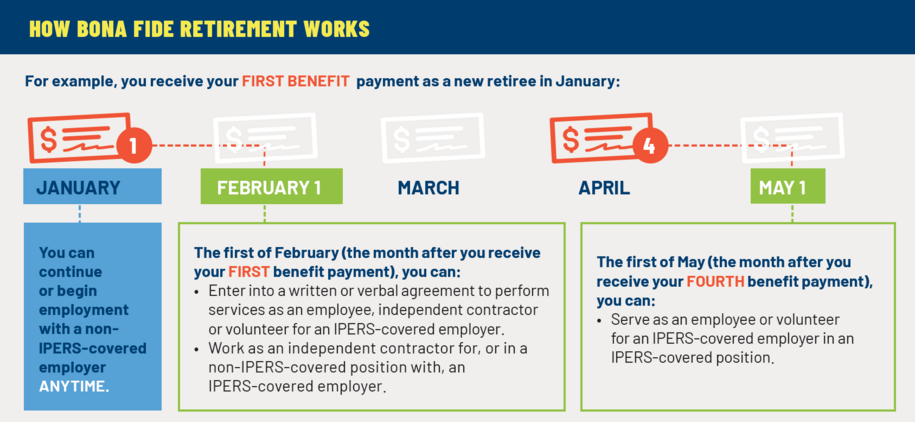
IPERS members who retire and receive benefits before age 70 must have a bona fide retirement before they may return to work.
This means:
- You have submitted a retirement application and IPERS has approved it.
- You have left employment with all IPERS-covered employers, including non-covered positions with covered employers.
- You are receiving benefits.
- You have followed the time restrictions for providing services for an IPERS-covered employer (see chart below).
The qualification period begins with your first month of entitlement for retirement benefits as approved by IPERS.
You cannot enter into reemployment or independent contracting agreements, either written or verbal, before you have received at least one benefit payment from IPERS. You cannot work as an independent contractor for, or in a non-IPERS-covered position with, an IPERS-covered employer before you have received at least one benefit payment from IPERS. You may accept temporary employment after your first month of entitlement in your previous position. However, reemployment in your previous position can’t be used as a means of evading the bona fide retirement rules.
If IPERS learns you were hired as a temporary employee during the bona fide retirement period, and then, for whatever reason, your employer treats you as a covered employee immediately following the bona fide retirement period, IPERS will perform an audit. If IPERS learns your employer did not make reasonable efforts to fill the vacancy you left when you retired with a new permanent employee, IPERS will revoke your benefits.
Exceptions
- Working for a covered employer after age 70
If you are older than age 70, you may receive IPERS benefits while working for an IPERS-covered employer. After you end employment with an IPERS-covered employer, contact IPERS and apply for a recomputation of benefits. - Licensed Teachers
Bona Fide Retirement requirements may be different for retirees who return to work as licensed teachers. Visit our Licensed Teachers page to learn more. - Iowa National Guard members
You can be called to state duty during the bona fide retirement period without any benefit penalty. - Part-time elected officials
You may start receiving benefits while in office. When you intend to retire, please notify IPERS in writing of your intent to end all covered employment and end IPERS coverage for your elected position.